
How to Spot Awkward Postures at Your Workplace
Ergonomics risk assessment plays a key role in ensuring workplace safety and health. One of the main focus areas in such an assessment is identifying awkward postures, body positions that increase the risk of strain, discomfort, and long-term injury.
Workers in industries such as manufacturing, construction, healthcare, and even office settings may often adopt postures that move away from the body’s natural alignment, especially when tasks involve reaching, bending, or twisting for long periods.
The Guidelines on Ergonomics Risk Assessment at Workplace 2017 defines awkward posture as,
positions of the body while performing work activities that deviate significantly from the neutral position.
Examples include twisting, bending, over-reaching, working with the hands above the head, elbows above the shoulders, or working with the neck or back bent more than 30 degrees without support. A lack of ability to vary posture is also considered awkward.
Understanding what counts as an awkward posture is the first step toward reducing ergonomics risks. With clear recognition, organizations can better evaluate job tasks, implement suitable controls, and ultimately safeguard workers from preventable injuries.
In addition, the guidelines provide a practical checklist (Table 3.1: Checklist for awkward posture) to help classify whether specific body parts are involved in awkward posture tasks. This tool supports assessors in making consistent evaluations and ensures that risks are not overlooked during ergonomics risk assessments.
Awkward Postures in Shoulders
Shoulders play an important role in almost every type of work activity, from lifting and reaching to carrying loads. Because of their wide range of motion, they are also more likely to be exposed to awkward positions that increase strain and fatigue.
(a) Hands or Elbows Above Shoulder Level
Physical Risk Factor – Working with hand above the head OR the elbow above the shoulder.
Maximum Exposure Duration (continuously or cumulatively) – More than 2 hours per day
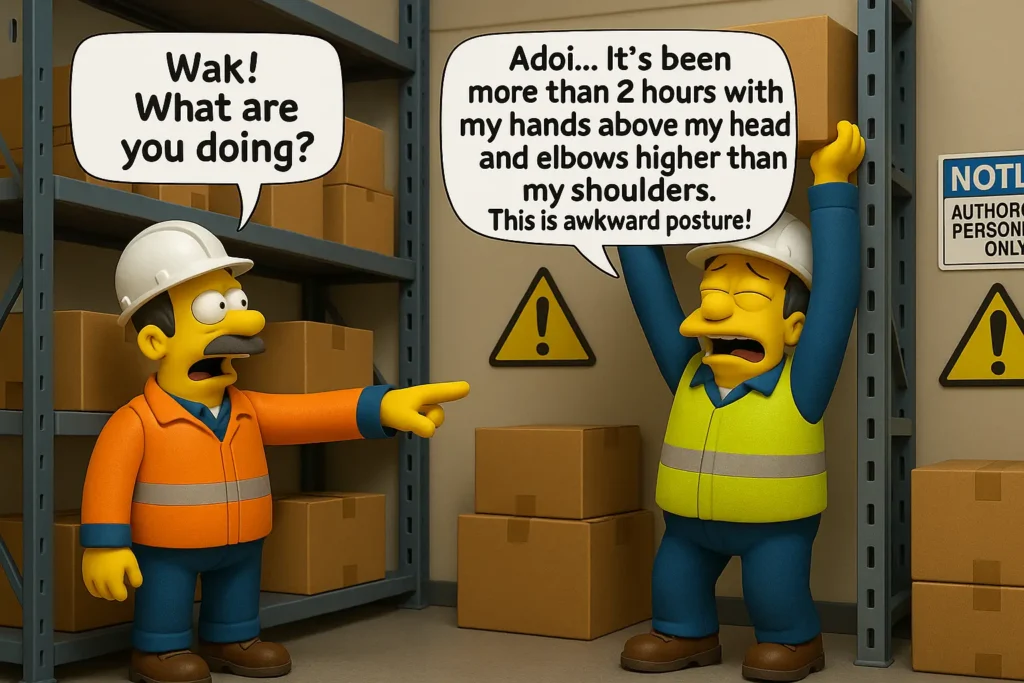
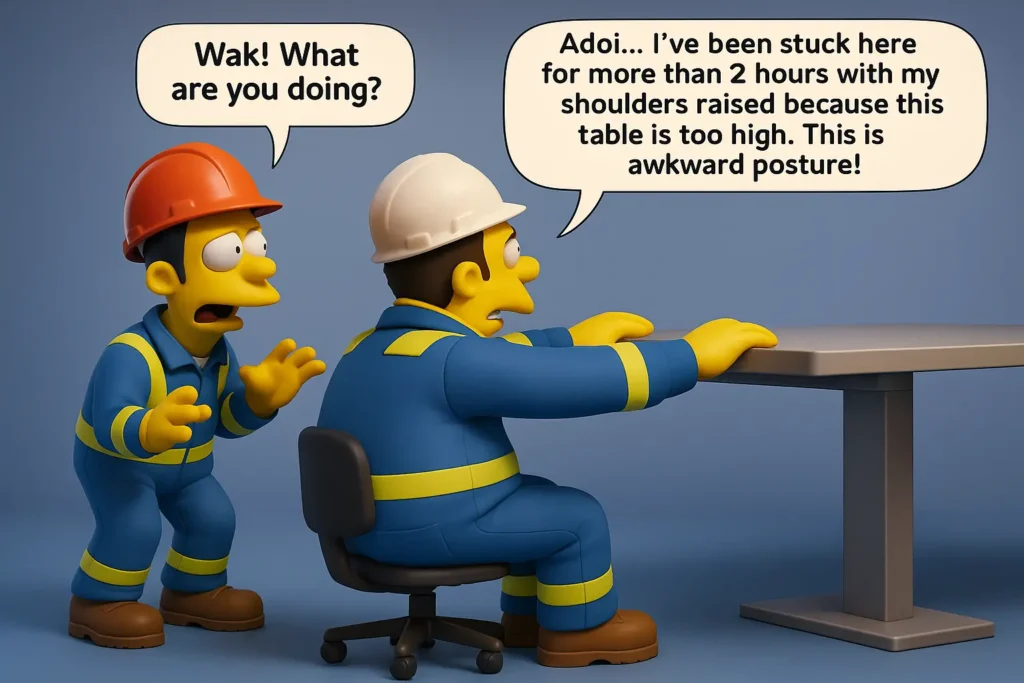
(b) Shoulders Raised
Physical Risk Factor – Working with shoulder raised.
Maximum Exposure Duration (continuously or cumulatively) – More than 2 hours per day
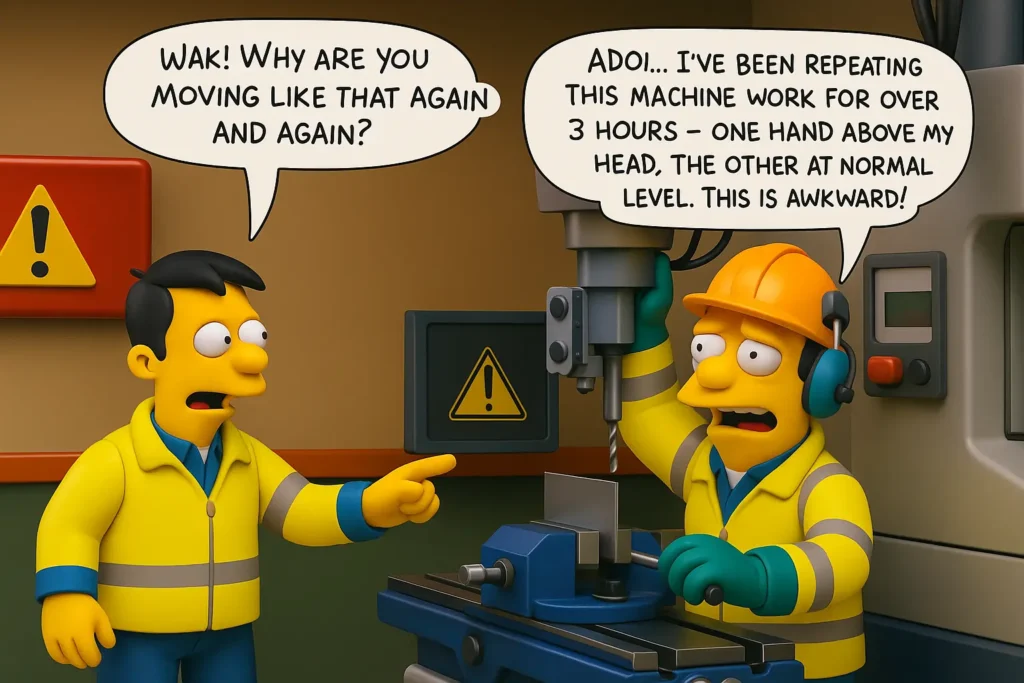
(c) Repetitive Overhead Work
Physical Risk Factor – Work repetitively by raising the hand above the head OR the elbow above the shoulder more than once per minute.
Maximum Exposure Duration (continuously or cumulatively) – More than 2 hours per day
Awkward Postures in Head
The head plays a central role in almost every work task, whether it involves looking down at documents, looking up at overhead equipment, or turning to observe different angles.
Because of this constant movement, the head and neck are highly vulnerable to awkward postures that, if sustained for long periods, can contribute to strain, discomfort, and musculoskeletal disorders.
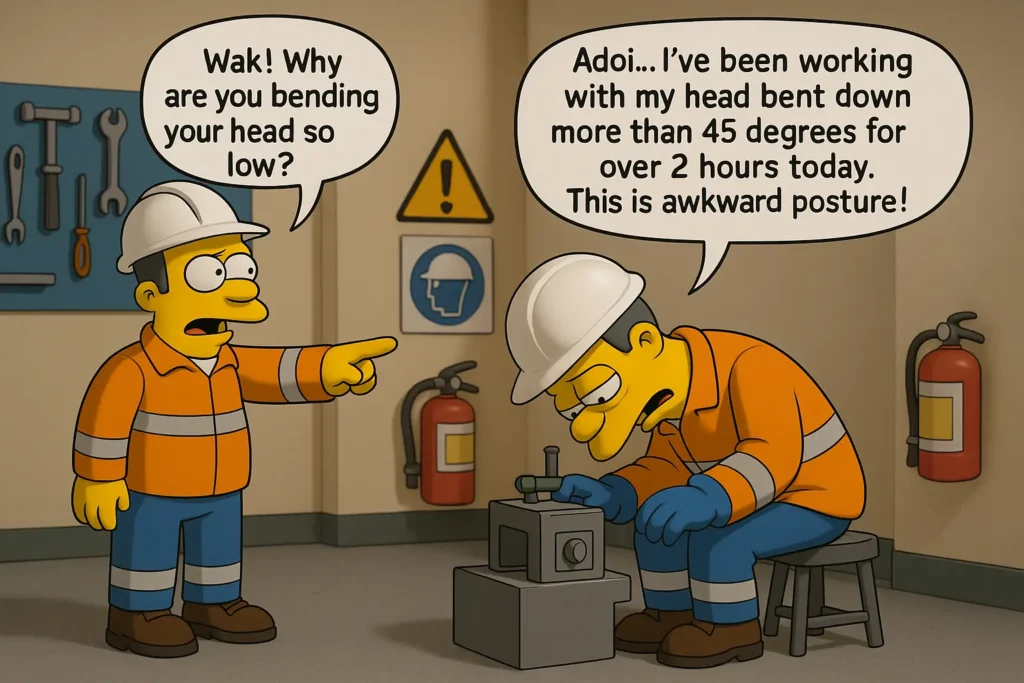
(a) Head Bent Downwards
Physical Risk Factor – Working with head bent downwards more than 45 degrees.
Maximum Exposure Duration (continuously or cumulatively) – More than 2 hours per day
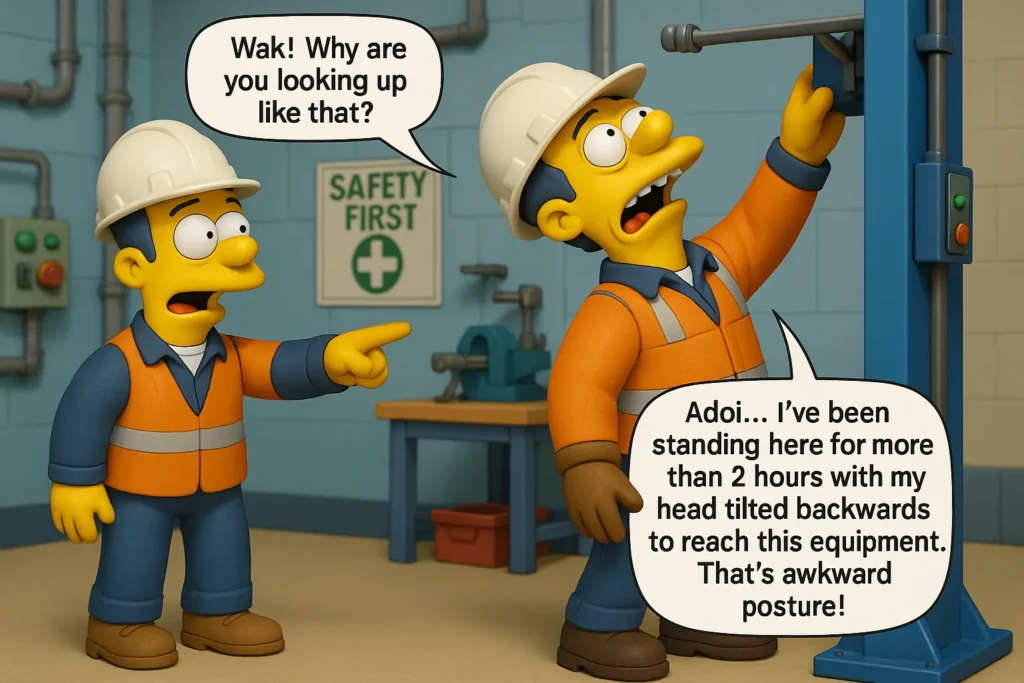
(b) Head Bent Backwards
Physical Risk Factor – Working with head bent backwards.
Maximum Exposure Duration (continuously or cumulatively) – More than 2 hours per day
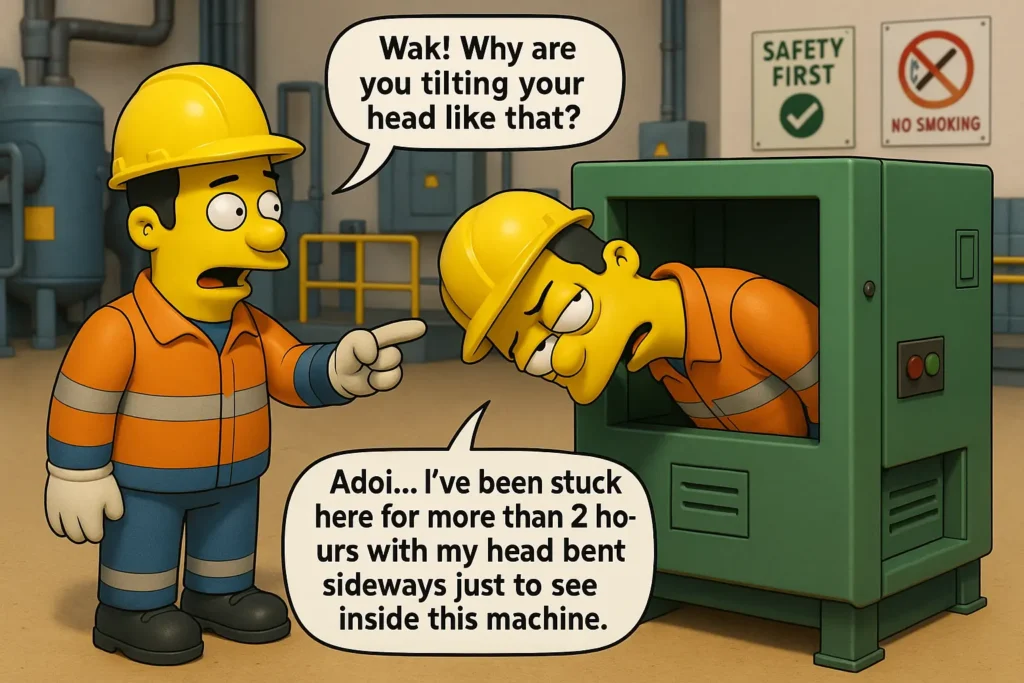
(c) Head Bent Sideways
Physical Risk Factor – Working with head bent sideways.
Maximum Exposure Duration (continuously or cumulatively) – More than 2 hours per day
Awkward Postures in Back
The back supports much of the body’s movement and load during work. When bent or twisted beyond natural alignment, it is especially prone to strain and long-term injury.
Awkward back postures are often seen in tasks involving lifting, bending, or reaching in constrained spaces, and if sustained for extended periods, they can contribute to musculoskeletal disorders.
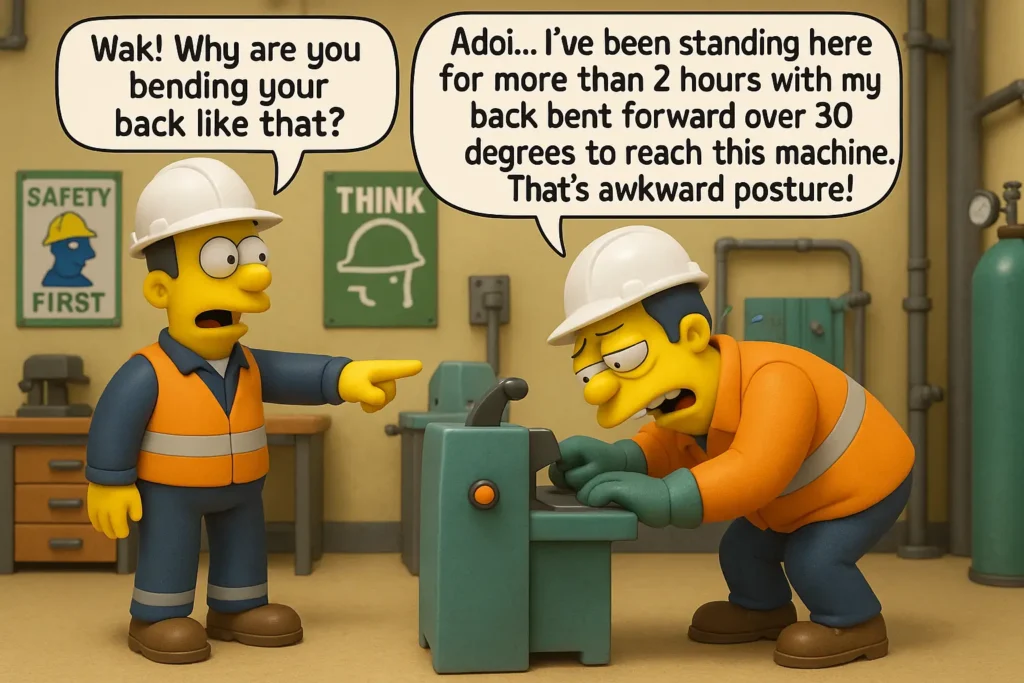
(a) Back Bent Forward or Sideways
Physical Risk Factor – Working with back bent forward more than 30 degrees OR bent sideways.
Maximum Exposure Duration (continuously or cumulatively) – More than 2 hours per day
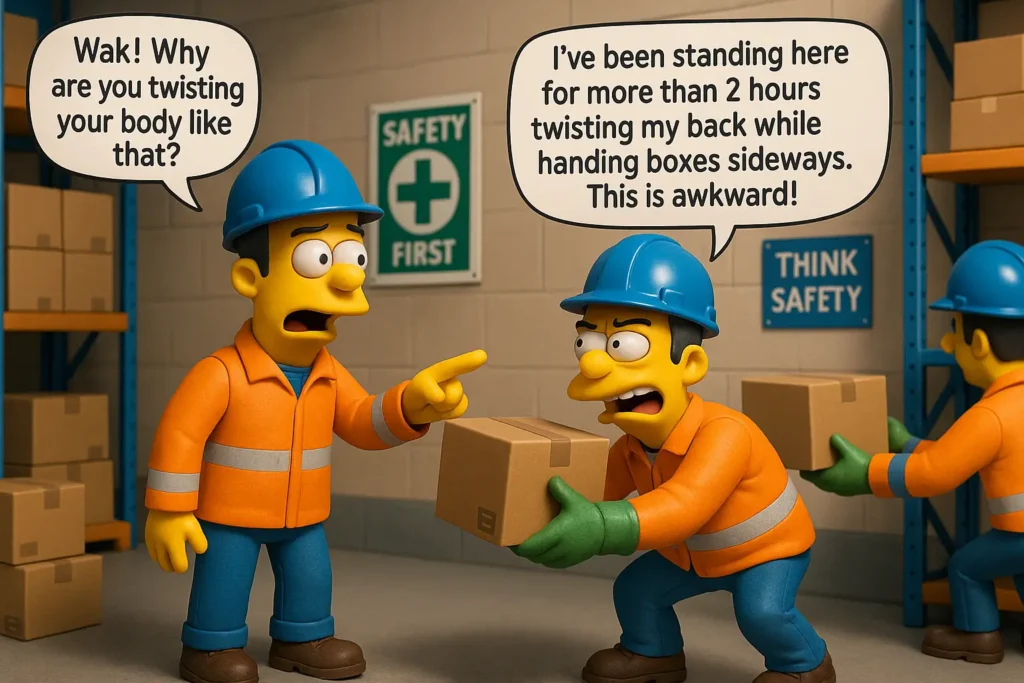
(b) Back Twisted
Physical Risk Factor – Working with body twisted.
Maximum Exposure Duration (continuously or cumulatively) – More than 2 hours per day
Awkward Postures in Hand, Elbow, and Wrist
The hand, elbow, and wrist are essential for precision, grip, and repetitive tasks in almost all types of work. When these joints are forced into extended or unnatural angles, especially for long durations, the strain can quickly accumulate and lead to musculoskeletal disorders such as tendonitis or carpal tunnel syndrome.
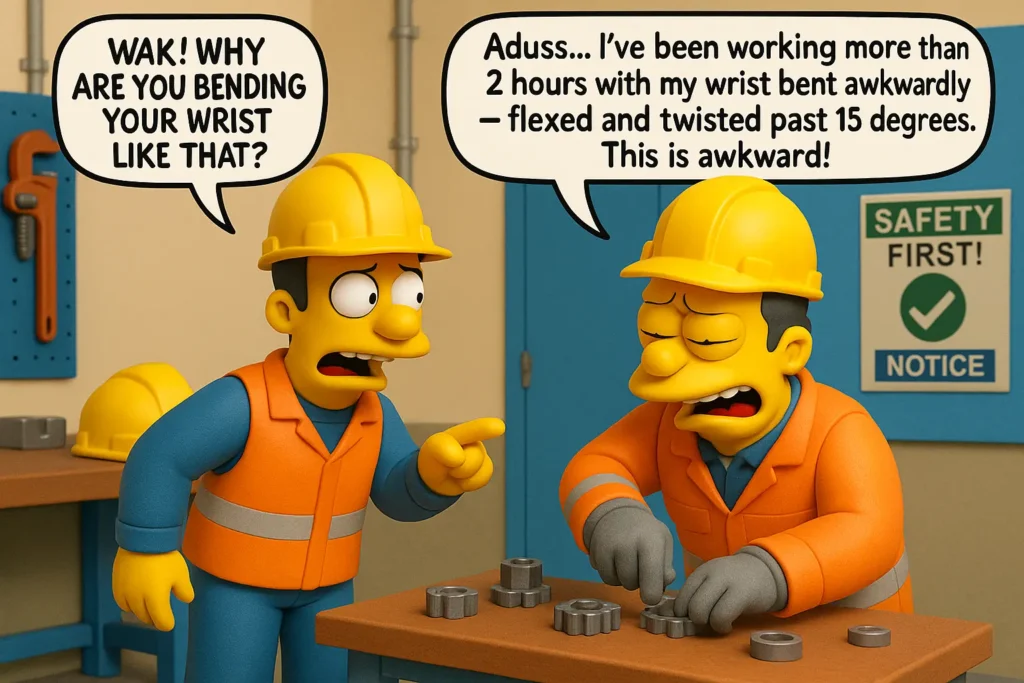
(a) Wrist Flexion, Extension, or Radial Deviation
Physical Risk Factor – Working with wrist flexion OR extension OR radial deviation more than 15 degrees.
Maximum Exposure Duration (continuously or cumulatively) – More than 2 hours per day
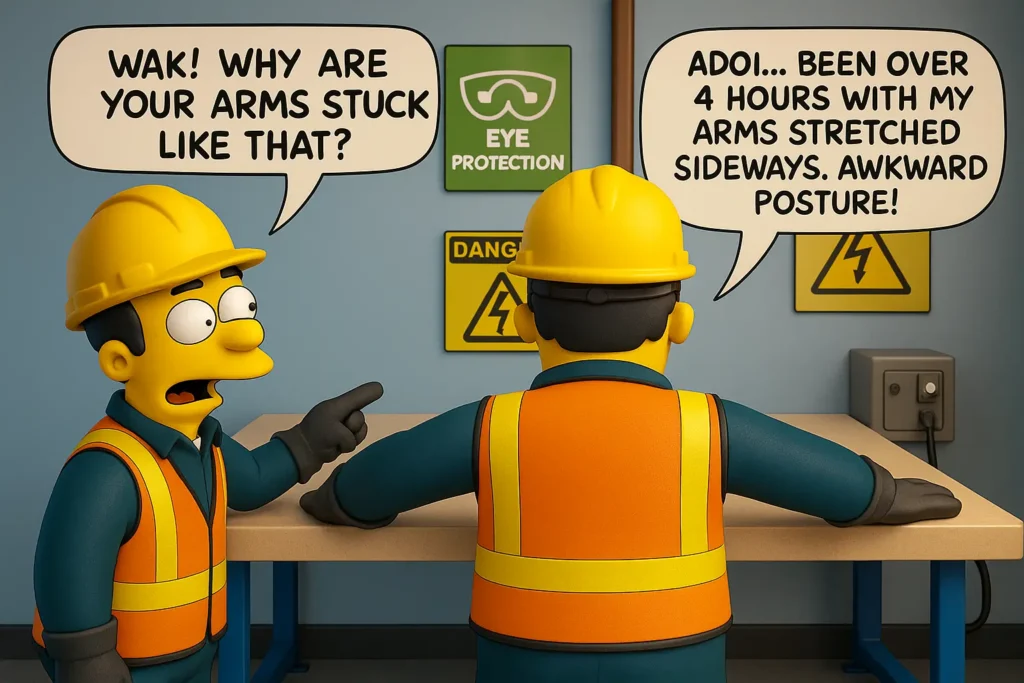
(b) Arm Abducted Sideways
Physical Risk Factor – Working with arm abducted sideways.
Maximum Exposure Duration (continuously or cumulatively) – More than 4 hours per day
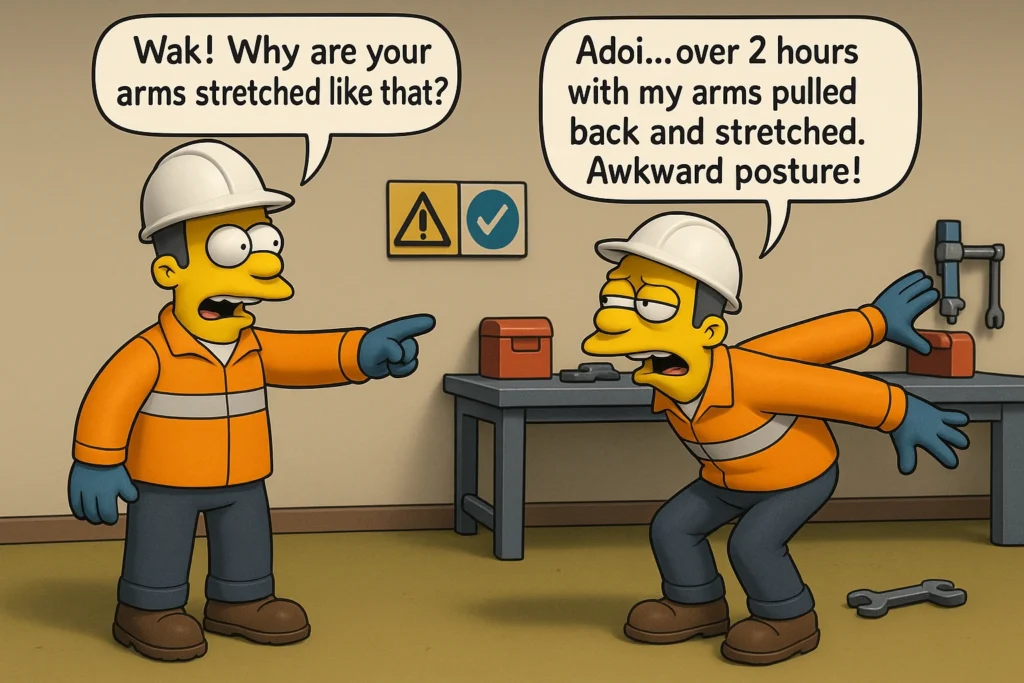
(c) Arm Extended Forward or Backward
Physical Risk Factor – Working with arm extended forward more than 45 degrees OR arm extended backward more than 20 degrees.
Maximum Exposure Duration (continuously or cumulatively) – More than 2 hours per day
Awkward Postures in Legs and Knees
The legs and knees provide stability and support during almost all work activities. When workers are required to stay in positions such as squatting or kneeling for extended periods, circulation and joint health can be affected, leading to discomfort, strain, or long-term musculoskeletal issues.
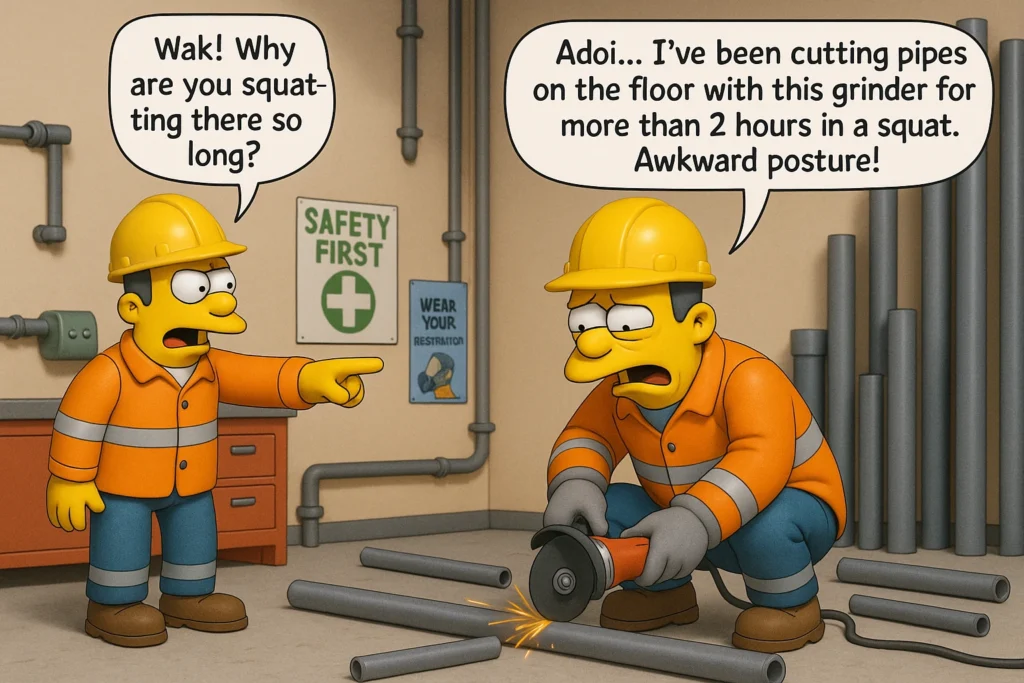
(a) Squatting Position
Physical Risk Factor – Work in a squat position.
Maximum Exposure Duration (continuously or cumulatively) – More than 2 hours per day
(b) Kneeling Position
Physical Risk Factor – Work in a kneeling position.
Maximum Exposure Duration (continuously or cumulatively) – More than 2 hours per day

Using the Checklist to Determine for Advanced Assessment
The total score for awkward posture is 13, with 1 point assigned for each YES ticked. If the assessment records 6 or more YES responses, an advanced ergonomics risk assessment is required.
| Body Part | Physical Risk Factor | Maximum Exposure Duration (continuously or cumulatively) | Tick if YES |
|---|---|---|---|
| Shoulders | Working with hand above the head OR the elbow above the shoulder | More than 2 hours per day | |
| Working with shoulder raised | More than 2 hours per day | ||
| Work repetitively by raising the hand above the head OR the elbow above the shoulder more than once per minute | More than 2 hours per day | ||
| Head | Working with head bent downwards more than 45 degrees | More than 2 hours per day | |
| Working with head bent backwards | More than 2 hours per day | ||
| Working with head bent sideways | More than 2 hours per day | ||
| Back | Working with back bent forward more than 30 degrees OR bent sideways | More than 2 hours per day | |
| Working with body twisted | More than 2 hours per day | ||
| Hand / Elbow / Wrist | Working with wrist flexion OR extension OR radial deviation more than 15 degrees | More than 2 hours per day | |
| Working with arm abducted sideways | More than 4 hours per day | ||
| Working with arm extended forward more than 45 degrees OR arm extended backward more than 20 degrees | More than 2 hours per day | ||
| Legs / Knees | Work in a squat position | More than 2 hours per day | |
| Work in a kneeling position | More than 2 hours per day |
Conclusion
Awkward postures, if sustained or repeated, increase the risk of strain and musculoskeletal disorders. The ergonomics risk assessment checklist helps identify these risks and track exposure.
A total score of 6 or more YES indicates the need for an advanced assessment. Address risks early by redesigning tasks, adjusting workstations, and training workers. Simple changes can prevent injuries, improve comfort, and maintain productivity.
Read
Guidelines on Ergonomics Risk Assessment at Workplace 2017, DOSH Malaysia. Retrived from https://dosh.gov.my/perundangan/garis-panduan/ergonomik/