
Work at Height – Best Onsite Fall Risk Controls
Work at height is among the riskiest tasks on any site, and falls remain one of the leading causes of workplace fatalities worldwide. The challenge for safety professionals and managers is that even the smallest slip can turn deadly, making this hazard especially difficult to control.
To address this, DOSH Malaysia outlines a clear hierarchy of fall protection. These are practical steps that, if followed, can prevent most accidents. From eliminating hazards to applying the right safety gear, each level brings us closer to a safer worksite.
Let’s explore the best onsite controls, from eliminating the hazard to administrative control that you can start using today.
Eliminate the Need to Work at Height
The most effective way to prevent falls is to remove the hazard completely. If no one is exposed to height, the risk of falling is zero. This starts at the design table. Engineers, architects, and planners should think forward: how will we install this, how will we maintain it, and how will we replace it years later without leaving the ground ?
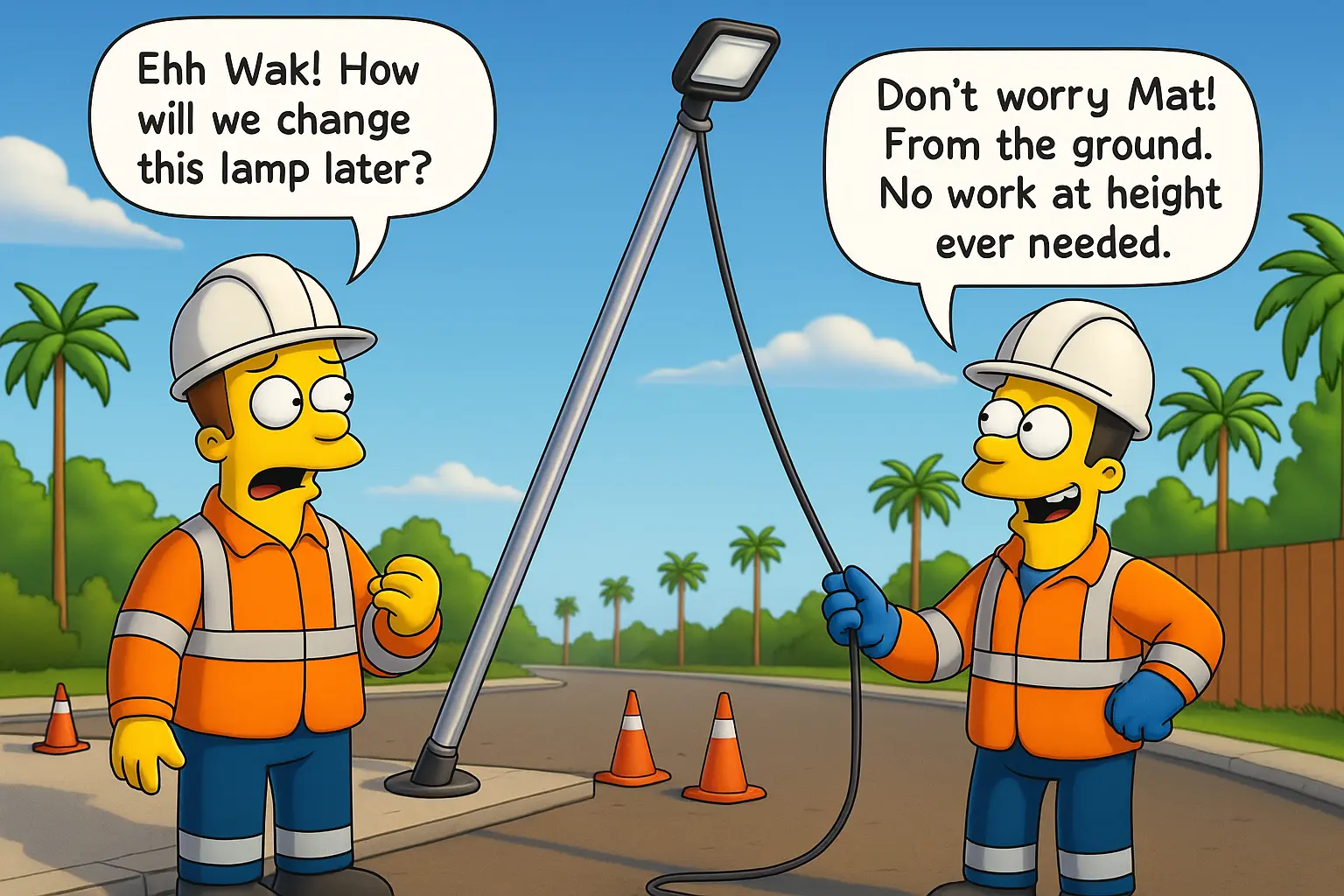
Design thinking in practice:
- Use collapsible or mid-hinged poles – Specify street light poles with a base or mid-hinge and a manual winch so luminaires can be lowered to ground level for lamp changes and wiring checks. No ladder, no MEWP, no work at height.
- Bring services to reachable zones – Place AHUs, filters, ballasts, CCTV, and signage where they can be accessed from platforms or the floor. Use swing-down brackets for small fixtures.
- Choose modular components – Design for slide-out cartridges, plug-and-play drivers, and quick-release fittings so replacement happens at a safe height.
- Avoid creating high tasks for minor gains – If a feature adds little functional or aesthetic value but will require future climbing, omit it or relocate it to an accessible height.
Realistic example:
A façade design includes decorative uplights mounted 12 meters high along a parapet. They look nice at handover but require lamp and driver changes every one to two years using a boom lift.
The safer decision is to move the lights to a 3–4 meter serviceable band with tilt brackets, or delete the feature if the visual impact is minimal. The long-term result is zero routine work at height for that element.
Restrict Workers From Reaching the Edge
When you cannot eliminate work at height, your next priority is to stop people from ever reaching the edge. Fall restraint is prevention, not protection after the fact. It sets physical limits so routine tasks stay inside a safe envelope.
This control shines on roofs, mezzanines, platforms, and near floor openings, and works best when designed in from day one with anchors, guardrails, and fixed paths planned around real tasks.
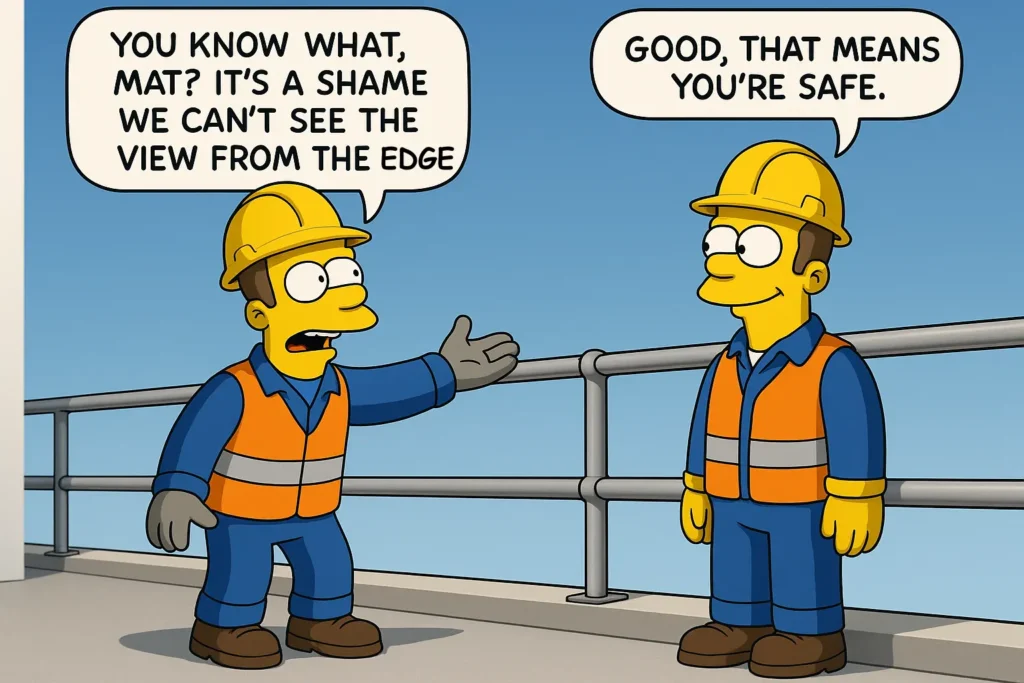
A restraint setup fixes the user’s maximum reach. If the lanyard length is shorter than the distance to any edge or opening, a fall cannot occur. This reduces reliance on perfect behavior and focuses on simple physical limits. It also simplifies supervision because the system makes the unsafe position unreachable.
Examples onsite:
- Guardrails and parapets at roof perimeters, mezzanines, and around floor openings.
- Travel-restraint lanyards cut to length so users cannot reach an edge from their anchor.
- Temporary barriers and warning lines to isolate active work zones.
- Secured, load-rated covers over holes and skylights with clear labeling.
- Permanent walkways and platforms that define safe routes to equipment.
Protect Everyone Through Passive Systems
Passive fall protection means systems that keep workers safe without needing them to take extra steps. Once in place, the protection is always active. Workers do not have to clip on, adjust lines, or make constant decisions. The safety is built into the environment and works by default.
The principle is simple: when you cannot get to the edge, you cannot fall. Barriers and range-limited PPE all serve this purpose by making the danger zone unreachable.
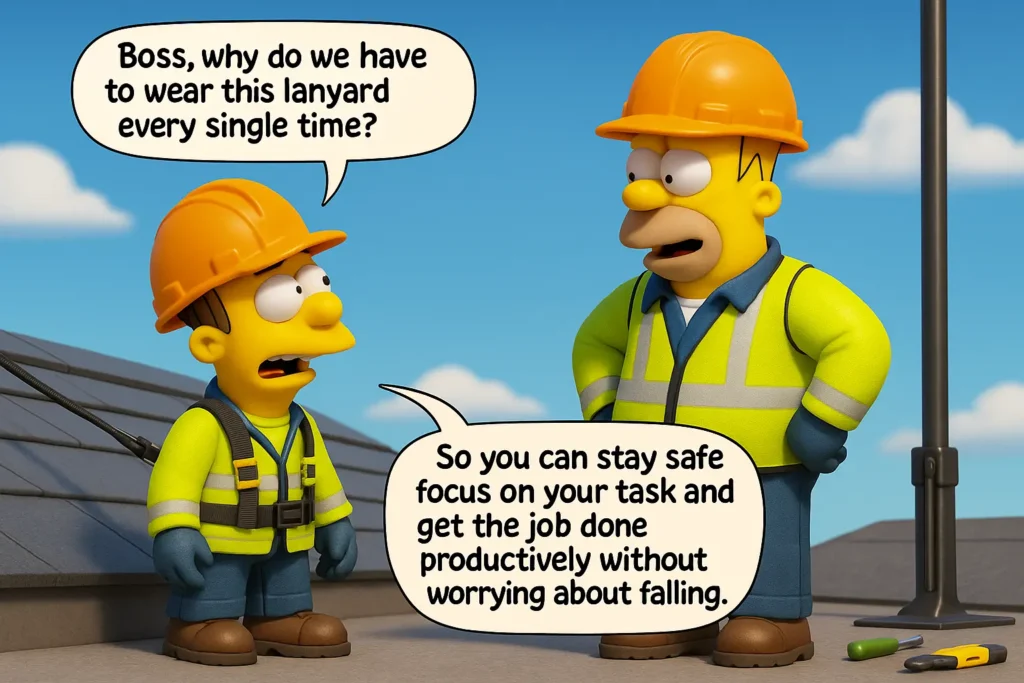
For example, a short lanyard can be set so the worker cannot move close enough to an edge. In effect, it works the same as a restraint system, because the line is too short to reach the fall hazard.
Arrest the Fall Before It Hits the Ground
A fall arrest system is actually the last line of defense but it often misunderstood as the first one by many. It does not stop a worker from falling, but it stops the fall before the worker hits the ground or a lower level.
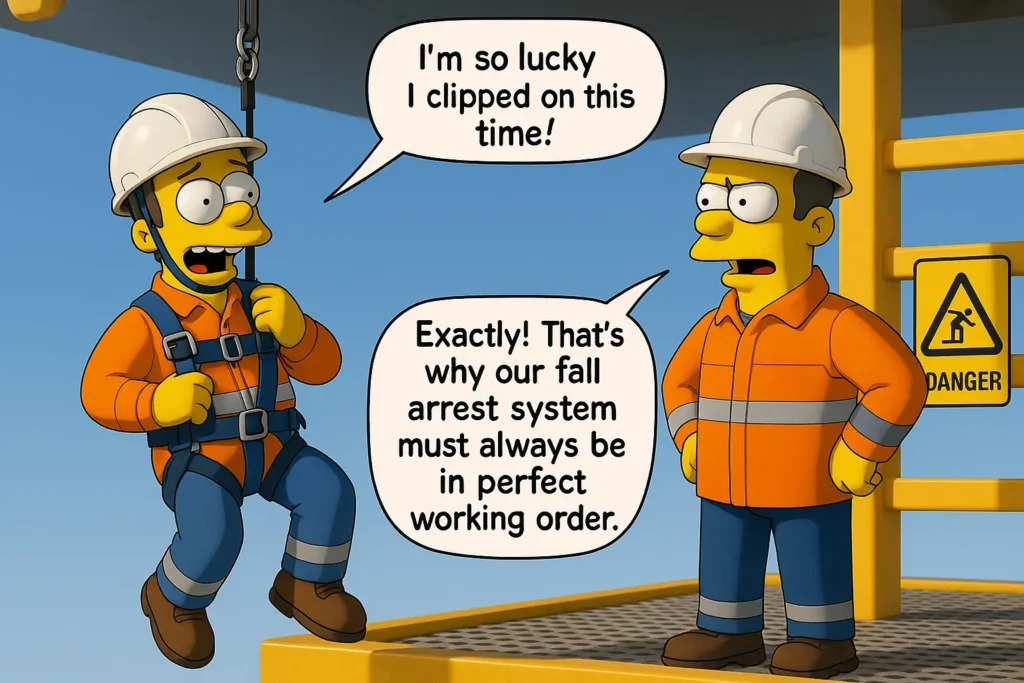
This system is used only when elimination, restraint, or passive protection cannot be applied. Because the worker is exposed to a fall, it must be carefully designed, inspected, and used correctly.
Key components of a fall arrest system:
- Full body harness – Distributes the force of a fall across the shoulders, thighs, chest, and pelvis. Waist belts alone are not suitable.
- Connecting device – Usually a lanyard with shock absorber, a retractable lifeline, or rope grab. It links the harness to the anchor point and controls deceleration.
- Anchor point – A fixed or certified structure strong enough to withstand fall forces, typically rated at least 15 kN in Malaysia. Anchors may be permanent or temporary.
- Fall clearance distance – The minimum space below the worker required for the system to stop a fall safely without hitting lower levels or obstacles.
- Rescue plan – A detailed procedure to retrieve a worker quickly after a fall, since suspension trauma can occur within minutes.
Strengthen Safety with Training and Procedures
Administrative controls are the lowest level in the hierarchy of fall protection. They do not remove the hazard or physically stop a fall.
Instead, they rely on rules, procedures, training, and supervision to reduce the chance of accidents. Because these measures depend heavily on people’s behavior, they should never stand alone but can support the higher levels of control.
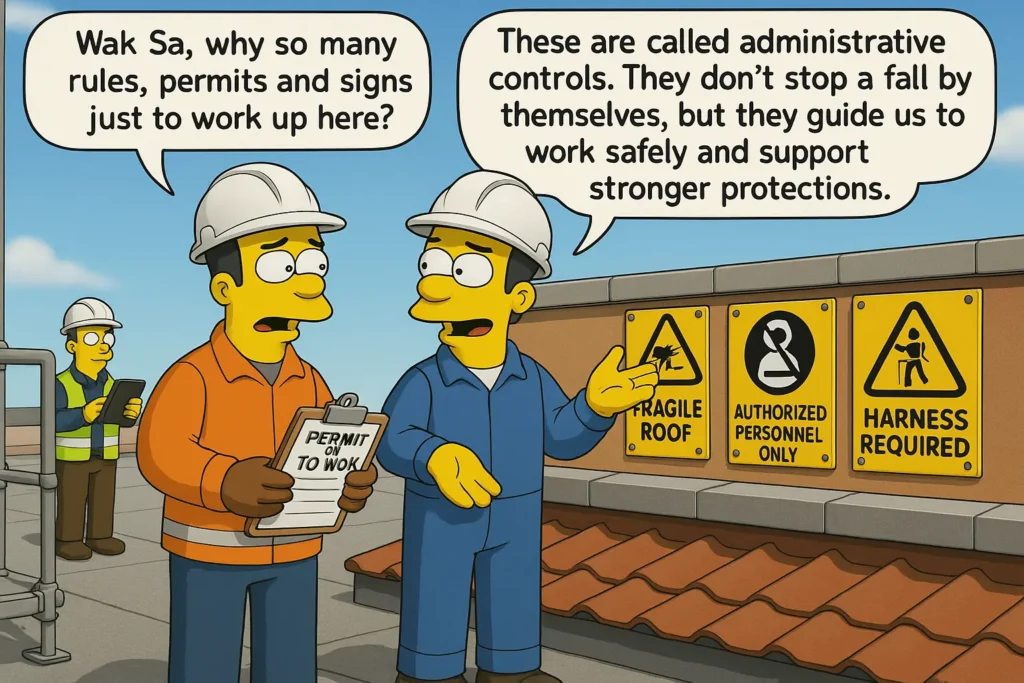
What administrative controls include:
- Safe work procedures – Step-by-step instructions for using ladders, scaffolds, or MEWPs.
- Permit-to-work systems – Formal approval before starting high-risk activities such as roof work.
- Training and awareness – Ensuring workers understand hazards, equipment use, and emergency steps.
- Signage and warnings – Clear notices around fragile roofs, open edges, or restricted zones.
- Supervision and monitoring – Competent persons checking that workers follow safe methods.
Active vs Passive Fall Protection
Whether you are aware of the terms or not, you are likely to find them being used quite often in the industry. Active and Passive Fall Protection are two different approaches to keeping workers safe at height.
Knowing the difference matters because it affects how much you rely on worker behavior versus built-in safety measures.
Passive protection tends to be more reliable since it works automatically once in place, while active protection can be highly effective but requires correct use, discipline, and training.
When deciding which type of protection to apply, consider these factors:
- Nature of the task – Is the work routine and repeated, or temporary and complex?
- Work duration – Short tasks may not justify a full passive system, while long-term areas benefit from permanent solutions.
- Number of workers exposed – Passive methods are better for large groups, active gear can be managed for individuals.
- Environment – Weather, space constraints, and ground conditions may limit certain systems.
- Maintenance and practicality – Can the protection be kept in place easily, or does it need worker action each time?
The table below highlights the key differences between the two approaches:
| Aspect | Active Fall Protection | Passive Fall Protection |
|---|---|---|
| Definition | Systems that require the worker to actively use or engage the equipment (e.g., harness, lanyard, lifeline). | Systems that protect workers automatically once installed, without needing action from the user (e.g., guardrails, covers). |
| Worker Action Needed | Yes. Workers must wear, connect, and adjust equipment properly. | No. Safety is built into the environment and always present. |
| Examples | Full body harness with fall arrest system, travel restraint lines, lifelines. | Guardrails, toe boards, safety nets, secured covers, range-limited PPE. |
| Effectiveness | Effective if used correctly, but relies heavily on worker training and discipline. | Highly reliable because it does not depend on worker behavior once in place. |
| Best Use | When elimination or passive methods are not possible, especially for temporary or high-exposure tasks. | As a first line of defense for routine tasks, areas with many workers, or public interfaces. |
Conclusion
Authorities and industry experts have long studied the causes of falls and developed a clear hierarchy of risk controls that are proven to prevent them. These controls are not theory, they are based on real accidents, lessons learned, and years of research.
For employers and project owners, the first duty is to provide the best controls that are reasonably practicable. A guardrail, a restraint line, or a well-designed access system may look like an expense, but it is an investment that saves lives. Even preventing a single fall means avoiding a tragedy that no cost or schedule can justify.
For workers, the responsibility is just as real. Having the right equipment or systems in place means nothing if they are ignored or bypassed. Complying with the controls provided is part of valuing your own safety and the safety of your team.
At the end of the day, the tension often lies between safety and speed, safety and cost, or safety and unnecessary paperwork. But when you weigh it against a life, the choice should never be difficult.
The bottom line – you can replace time and money, but you can never replace a life.
Read
Hierarchy of Fall Protection, DOSH Malaysia
Guidelines for the Prevention of Falls at the Workplaces, DOSH Malaysia